Kim Newman: horror, history and the real world behind fantasy
An interview with Andrew Marc
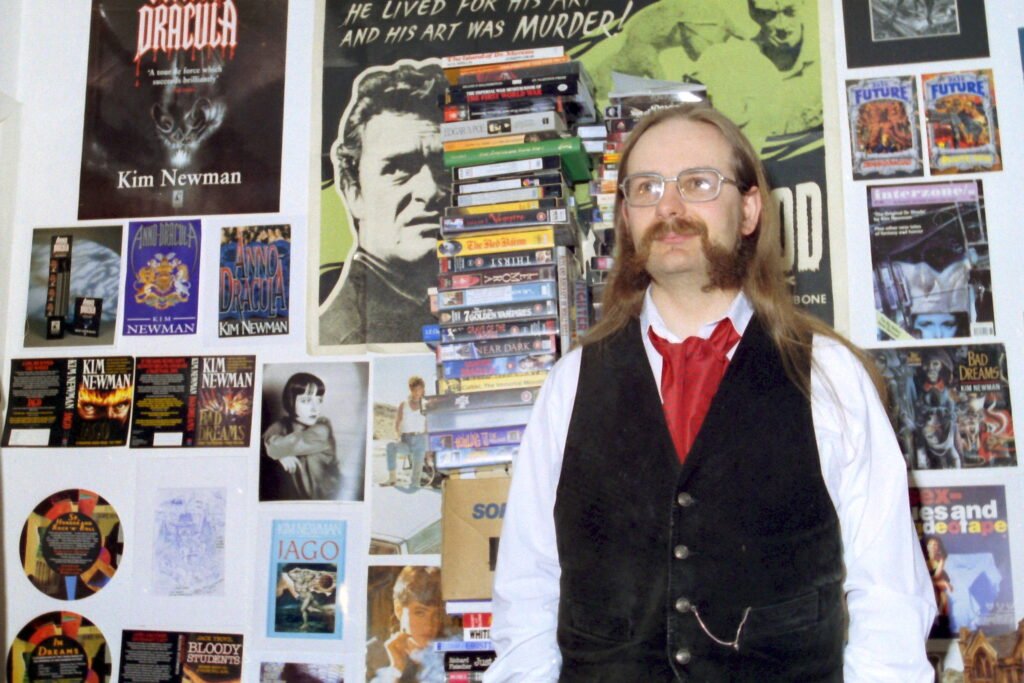
By the 1990s, Kim Newman had already become one of the most distinctive voices in British genre culture: a critic, novelist and broadcaster with a deep knowledge of horror, fantasy and cinema history, and a body of fiction that refused to stay neatly in one box. Known for works including Anno Dracula, The Night Mayor, Jago, The Quorum, Bad Dreams and Nightmare Movies, Newman occupied that uncommon space between criticism and creation, writing about films with wit and authority while producing fiction alive with well observed popular culture, history and the strange ways fantasy bleeds into the real world.
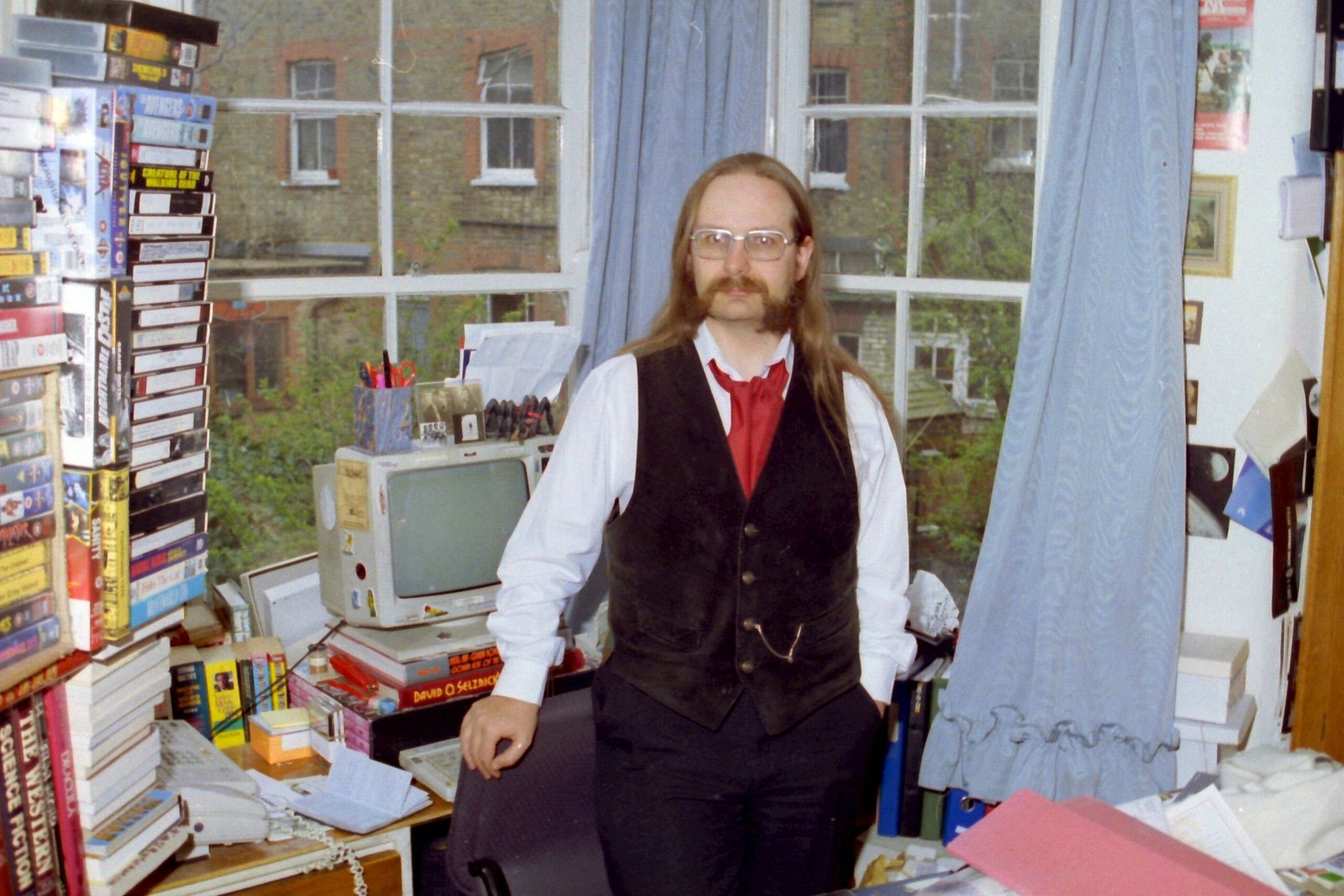
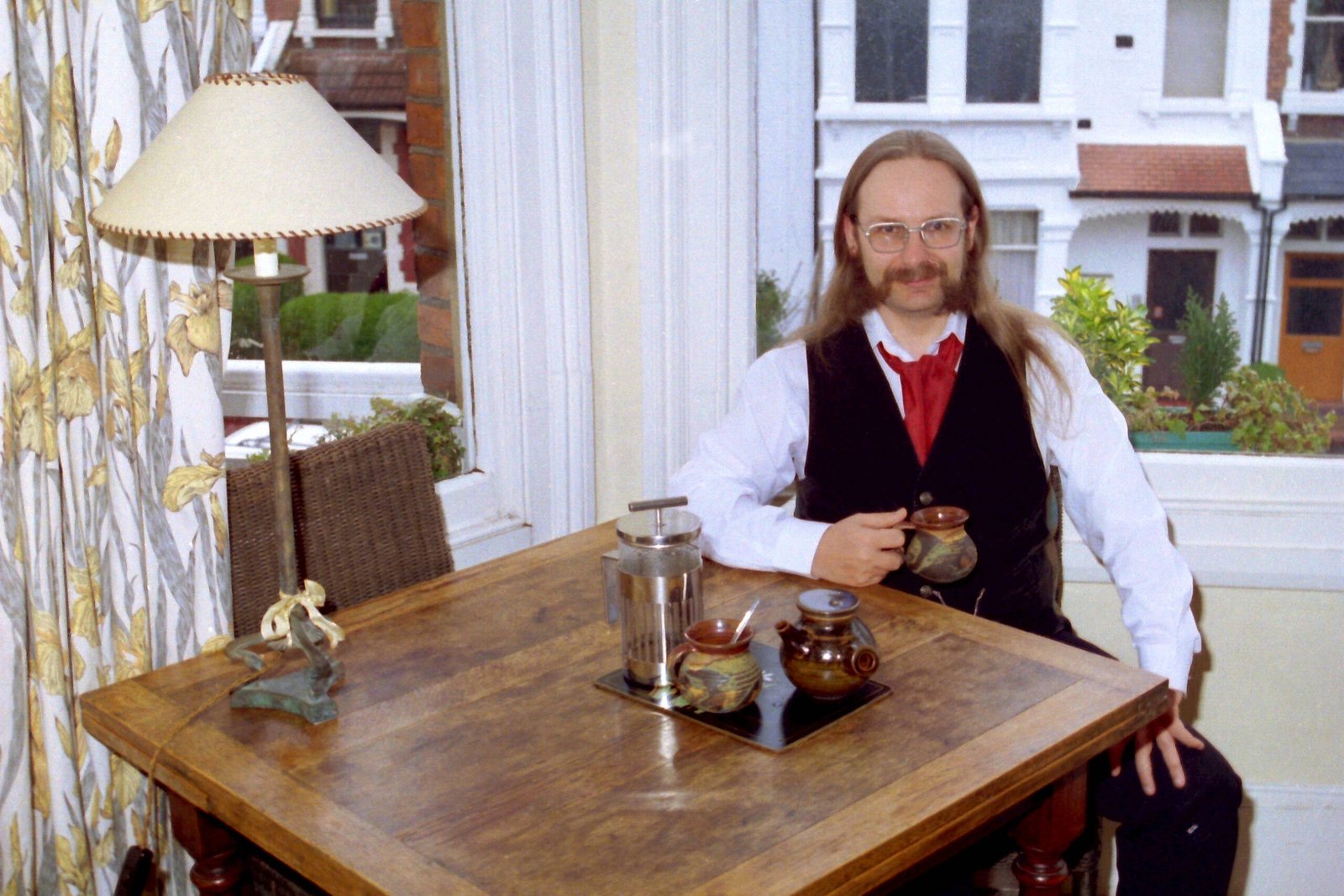
I met him in his Crouch End flat and found him to be was warm, candid and very funny; he was also very generous with his time, unpretentious, and quick to undercut any grand idea of career planning or literary myth-making. What follows is an unpublished conversation which includes as much of Kim’s thoughts as possible, which were volumous: he talks about criticism, fiction, horror, influence, publishers, censorship, Neil Gaiman, Clive Barker, film adaptations and the importance of keeping even the wildest fantasy grounded in something emotionally real. He began, characteristically, by refuting the idea that any of his writing, reviewing and presenting had been planned.
“I never really wanted to do anything,” he said, laughing. “I got into this completely by accident.”
As far back as he could remember, writing and film had always been intertwined. He started writing stories at eight or nine, then moved on to staging plays at school, often adapted from horror films he had seen as a child. There were early short stories, abandoned novels and the usual mountain of juvenilia, most of which he was happy to think had disappeared.
‘One of the great things,’ he said, ‘is having written all the crap out before I was twenty-one. Many people in their thirties and forties are still writing their crap.’
As a teenager, he also began keeping notes on every film he saw, at first a paragraph, then eventually a page at a time. It was never intended for publication, just the private obsession of a film-mad schoolboy. But it turned out to be one of the most useful habits of his professional life.
‘Having this body of stuff means that things I’ve consciously forgotten I can still write about because I can go back and look at the notes and find details of the story, or what impressed me about the film, what didn’t impress me. Often, of course, if it’s a film I’ve seen subsequently, I’ll have scribbled something over it — “this is wrong!” — but that has proved to be an invaluable resource.’
Leaving university in 1980, in the depths of recession, Newman found himself unable to get work. He applied for dozens of jobs, did bits of writing, worked with theatre groups and cabaret bands, and eventually began sending reviews out.
In time, Monthly Film Bulletin and City Limits took him on. The money was poor, but the foothold into the business mattered.
‘It felt like a break,” he said. “Financially, it did very little. I didn’t get off the dole for about another nine months after that.’
It was the sale of Nightmare Movies that finally shifted things, though even that came with its own dark comedy. The publisher, he recalled, had “intriguing and innovative financialarrangements”, published the book, then promptly went bust before he saw any proper return from it. But, it existed, and later it was rewritten and republished properly.
There were also several early film books that never appeared – projects on stars like Marilyn Monroe and Al Pacino, useful at the time, but not work he particularly regretted losing. On the fiction side, one of the curiosities of his early career was the pseudonym Jack Yeovil, used for books he imagined as slightly separate from the rest of his work.
‘If I was doing it again I wouldn’t have used a pseudonym,’ he admitted. ‘I would have put my name on everything. It was probably because I didn’t know that the Jack Yeovil books would turn out to be popular.’
The pseudonym was never exactly a secret, and he sometimes used it, or other names, simply to avoid overexposing “Kim Newman” in
magazine journalism. Unlike Stephen King’s strategic use of a second identity, Newman’s decision had been casual, almost whimsical.
‘At that time, Kim Newman meant nothing in terms of fiction.’
FILM AND POPULAR CULTURE
If there was one thing impossible to separate from his fiction, it was film and popular culture. His novels are dense with references, echoes, invented cultural artefacts and cinematic overtones, something he knew some readers found energising and others found irritating.
‘All my books are shot through not only with the film industry, but with popular culture; references and overtones,” he said. “Occasionally I do feel that this limits the work and I know that some people find it irritating, but certainly in the novels I’ve written to date, the subject matter has so much been the effects of popular culture on the real world that it’s important to get that kind of stuff right.’
What clearly bothered him more was fake culture done badly, such as invented films, invented musicians, invented cultural references that did not feel remotely convincing.
‘It always bothers me in other people’s books where you read about made-up popular culture that’s just wrong, just impossible. So I always try and get those details right, to make the fake films or fake musicians credible.’
He was equally aware that he had never wanted to write the same book over and over again. Apart from the Jack Yeovil novels, he pointed out, he had not really repeated settings, characters or tone. Science fiction, horror, alternate history, fantasy, political unease, detective fiction — all of it bled together. “I get bored writing the same thing over and over again.”
That instinct lay behind his plans for The Bloody Red Baron, the follow-up to Anno Dracula, which he was then writing. It was, he said, a sequel, but “a good sequel” — not a repetition of the first book, but a move into the same world thirty years later, shifting from Victorian London to Europe during the First World War.
‘The first book, to me, was wrapped up with Jack the Ripper and Sherlock Holmes and fog and gaslight and hansom cabs. Whereas the next book is wrapped up with Biggles and Bulldog Drummond and Baron von Richthofen and biplanes.’
However, the new setting presented its own problem. The pleasures of adventurous historical fantasy were harder to balance against the appalling reality of the war itself. ‘It’s hard to try and keep the humour, good ripping-yarn feel I like about the first book just because the reality is so appalling.’
HISTORY AND TYRANNY
That sense of history as something more than decorative backdrop ran deep in his work. Anno Dracula, he explained, was never just about Victoriana. Like much fantasy and science fiction, it was a way of writing about the present from a different viewpoint.
‘The slow drift to tyranny in Britain was what first interested me,’ he said. ‘That’s why, to me, The Quorum grows almost immediately out of the ashes of Anno Dracula. Even though they’re very different types of books. I don’t like messages in books,” he said. “I hate that in films and I hate it in other people’s books. But what I try to do is, no matter how strange and fantastic the plots are, always to feel that there is a real world behind them, and that the people really hurt.’
That dislike of falsity extended to the horror field itself. Newman remained affectionate toward horror, and had no urge to abandon it or rebadge himself with some grander literary label, but he was plainly restless with formula.
‘What I am least attracted to is what I think of as mainstream horror – a nice young couple buy a haunted house, or creepy crawlies eat a whole town, all that kind of stuff. We’ve seen too many of those books.’
Stephen King, he said, he admired intermittently and very much. James Herbert he found much less satisfying. His own attempt to do something closer to mainstream horror had been Jago, though even there he had tried to stretch the form. ‘I accept that horror is the touchstone of what I do but I’m not sure how useful calling Anno Dracula or The Quorum strictly horror novels is.’
Anno Dracula, he pointed out, was as much a detective story, a science fiction novel and a historical romance as it was horror. The Quorum, meanwhile, used supernatural machinery while stripping away most of the expected horror furniture altogether.
He was similarly level-headed about originality and influence, subjects that often drove other writers into pompous or defensive claims. He distrusted the regular loud cry of “stolen idea”, and seemed far more interested in the murky workings of the subconscious. Recently, he said, he had watched a horror film written by someone he knew and noticed a remarkable number of similarities to one of his own earlier books. When he raised it, the writer openly admitted the resemblance — but had apparently never consciously realised it.
‘The subconscious thing is enormous,’ Newman said. ‘Twice in my life people have said, ‘this scene is a bit like…’ and named a film, and I’ve had to admit it was.’
Absolute originality did not really interest him as a purity test. What mattered was what a writer did with the material they inherited. His own books often drew on ancient stories and shared mythologies, but he believed that in recombining them, or twisting them through history and genre, genuinely new things could still emerge.
‘My last two books have taken two of the oldest, most used ideas — the Dracula story and the Dr Jekyll and Mr Hyde story — but oddly enough I think those are the two books of mine that had the most original ideas, because they do things with those stories that as far as I know nobody else has ever done.’
He was much the same on criticism. Having worked as a critic himself, Newman might have been expected to dread or resent reviews of his fiction. Instead, he seemed almost amused by how kind the response had been.
‘If anything I am treated rather more kindly than I deserve,” he said. “There are plastered-over cracks in my novels that only I seem to notice.’
He had no illusion that this would always last. Every writer he admired, he observed, had eventually produced something disappointing
or outright bad. He assumed he would too. Film and television formed another long thread in the conversation. Newman had already become a visible media presence, but remained sceptical about the glamour of that side of the business. Projects stalled, options lapsed, producers walked and money vanished. A kind of theatre in its own right.
Both Anno Dracula and The Quorum had attracted screen interest, and in both cases he was attached as a screenwriter. But development was still mostly meetings and possibilities rather than finished work.
‘Basically, in both cases it’s me and two producers sitting down and talking through the book and what we see about it,” he said. Anno Dracula was being developed as an American mini-series, The Quorum as a British film, though he was under no illusion about how much might change if either actually went into production.
‘One of the reasons I’m so cautious about this is that I know a lot about how films get made, so I can’t really say I didn’t know when they went in and slaughtered my book. It’s all really useful, and really good stuff, and I’m really glad the producers have put their input in it,” he said. “But now it’s me — I’ve just got to do it… in the end, it’s all bullshit. It’s absolutely nothing to do with the writing. The writing is you and the machine.’
That may have been his clearest expression of the difference between prose and every other form. Television he enjoyed; he was still writing and presenting for the BBC, and was open to doing more if the project felt right. Film interested him too, especially adapting his own work. But novels remained the one place where he retained final cut.
‘A novel is mine,’ he said simply. ‘I’ve never done a television show which is mine.’
Elsewhere in the interview he spoke with equal sharpness about publishers, censorship, fanzine culture, the narrowing of genre taste
and the danger of younger writers mistaking recent hits for the whole history of horror. He had zero patience for people who thought A
Nightmare on Elm Street was the great classic while never having seen Nosferatu, and insisted that any serious grounding in film should take in much more than genre: Godard, Bergman, Fellini, Hawks, German Expressionism, Eastern European cinema, the whole gamut of cinema.
It didn’t feel like snobbery; it was breadth, range and cultural knowledge which is apparent with everything he does.