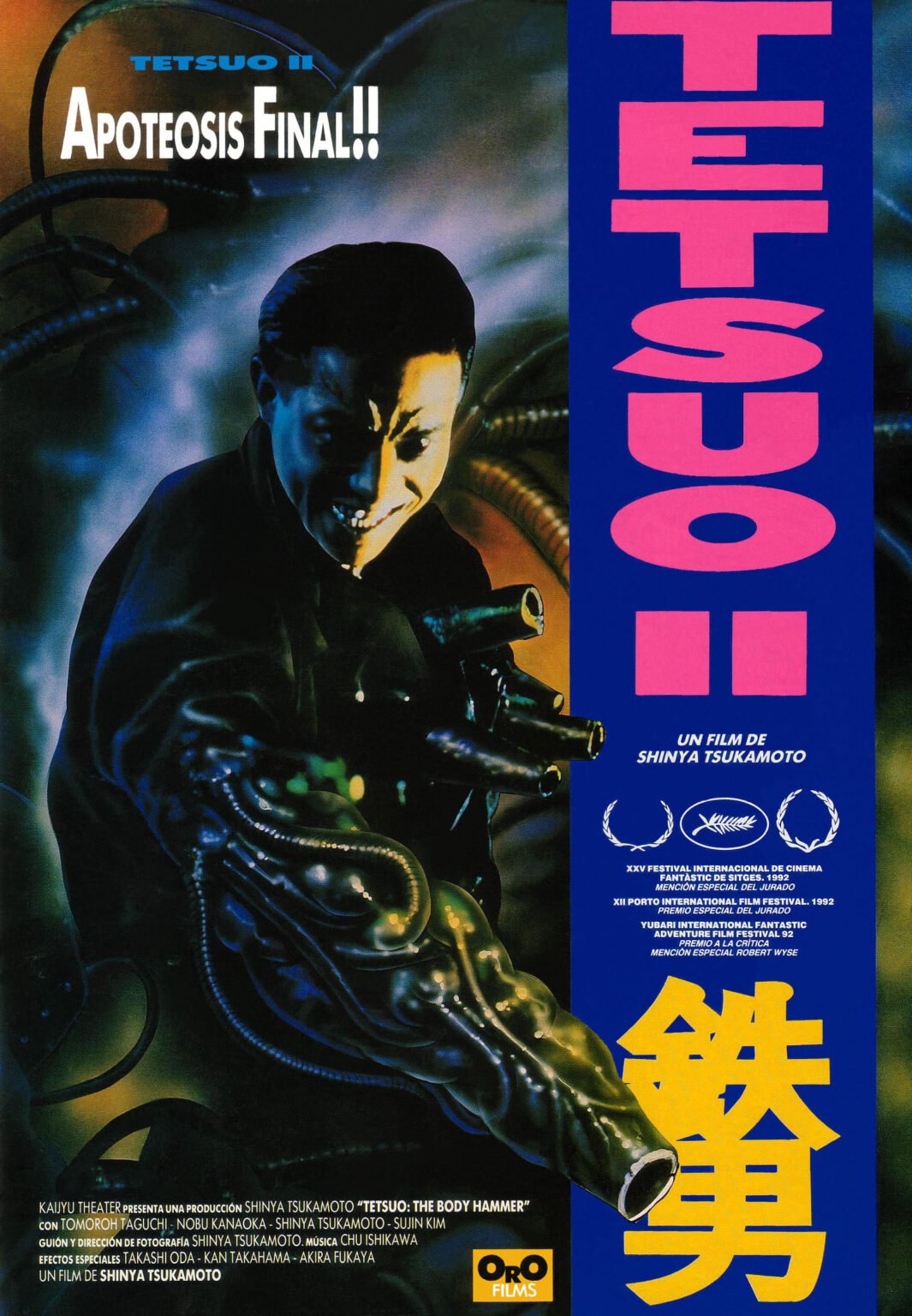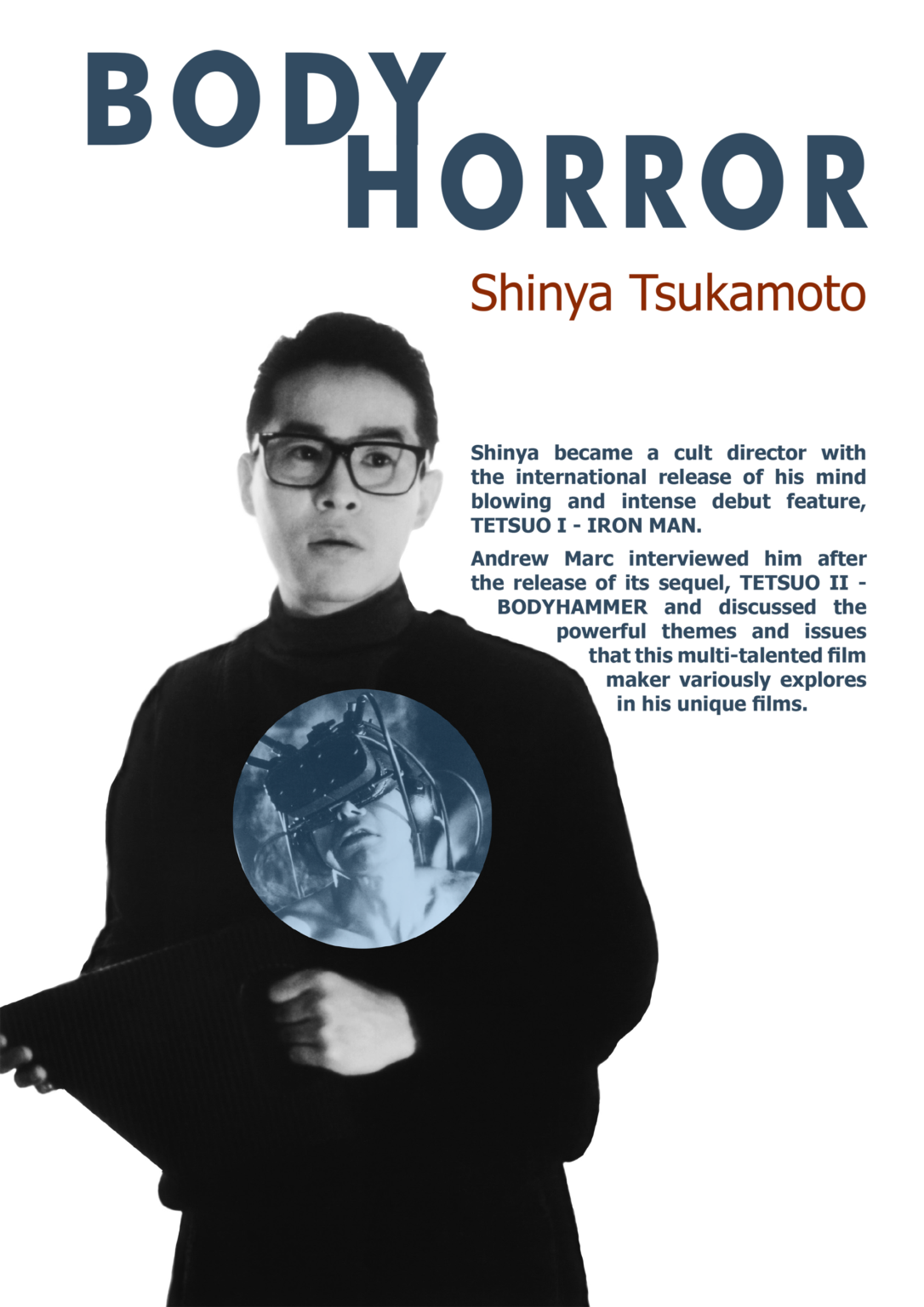
In 1989, a low budget Japanese film, shot in 16mm black and white, was shown at the Fantasporto Italian Film Festival in Porto. Such was its unique power and ferocity, its startling blood thirstiness, frenetic editing and outrageous visuals, that it won the film prize that year.
The director, 34 year old Shinya Tsukamoto, was suddenly recognised as a world class talent. His first feature (though barely qualifying with a running time of 67 minutes) was called Tetsuo – The Iron Man. The film’s protagonist was a conscientious salary man who accidentally runs down a ‘Metal’s Fetishist’ (played by Shinya himself) and then through a “psychic connection” as Tsukamoto calls it, the salary man also begins to mutate and transform into metal / human hybrid, tortured both by his terrifying predicament and the vengeful Metals Fetishist.
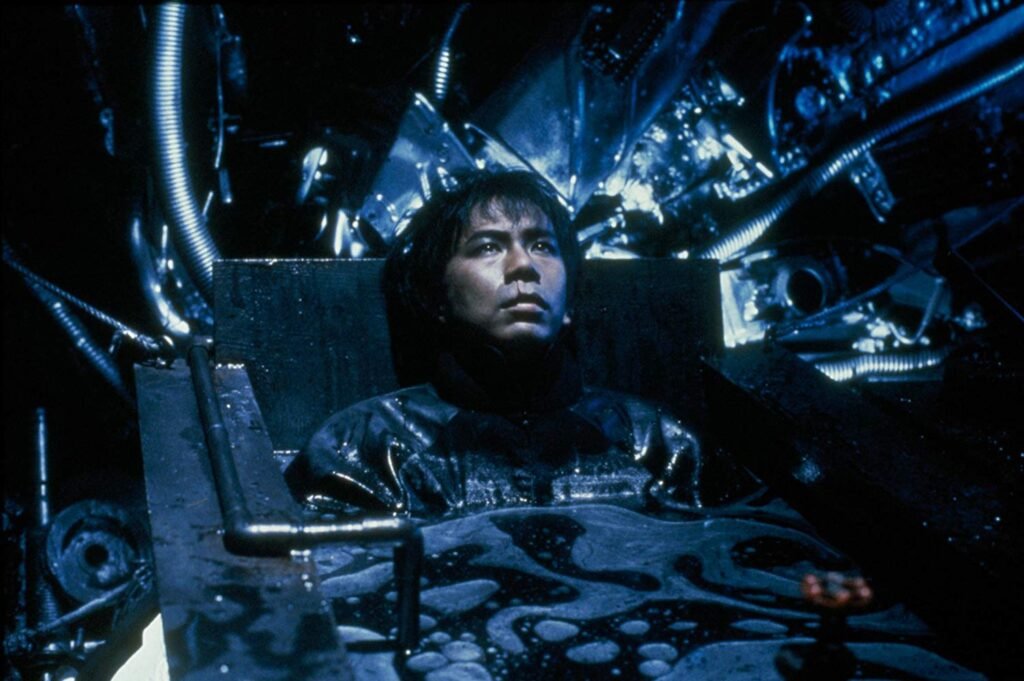
The film also explores the darker themes and codas that post-war repressive Japanese society perhaps subconsciously nurtured – sexual repression, destructive psychosis and rage. Tsukamoto initially funded Tetsuo himself (5 million yen), before contacting a video company for extra funds when his ran out, with a total cost of around 13 million yen. What makes this film extraordinary is its brazen visual style, incredible make-ups effects and bravura camera work, featuring awesome live-action stop motion scenes, jarring intercuts, acute use of disturbing sound effects and relentless cyberpunk attitude.
Tsukamoto as the Metals Fetishist adopts the punk look to great effect, looking wonderfully deranged and menacing. But it is the story line and film style which sets the film apart and made it into the cult classic it is today – explicit and unafraid; art house wrought with relentless monochromatic chaos. Tsukamoto has rightly been compared with David Cronenberg and David Lynch for his treatment of the ordinary gone bizarre, and obsession with ‘Body Horror’. The notion that the ultimate fear is from within – fear of the flesh.
Shinya takes this lead, but typifies his take on the body horror theme from an Eastern psychological viewpoint, much more brutally and obliquely. One of the most shocking scenes in Tetsuo is when Tomoo (played by Tomorowo Taguchi) is raped by his girlfriend who wields a writhing snake-like metal penis, clearly an analogous set piece, but one which Tsukamoto jokes “is probably a subconscious desire!”
Following the festival success in Japan, Tetsuo was first released in 1987 Italy and its acute manga influences, stomping industrial sound track (by the acclaimed Chu Ishikawa), unashamed perverseness and incredible visual style found favour with eclectic cinema fans.
The director then directed a studio film for television, a teen supernatural thriller called Hiruko The Goblin (never released outside Japan). Whilst visually arresting and genuinely creepy, it proved too sedate for the young auteur, and in 1992 a sequel to his first feature was completed: Tetsuo II – Bodyhammer.
Made in colour and again featuring the director in a lead role, Tetsuo II was deliberately more commercially styled, centering around a normal Tokyo family whose son is kidnapped by a skinhead gang in order to provoke the father to reveal his deeply hidden secret and fulfil the nefarious plans of the skinhead gang’s leader (Tsukamoto). Again, the film went on to win awards for its unique style and content.
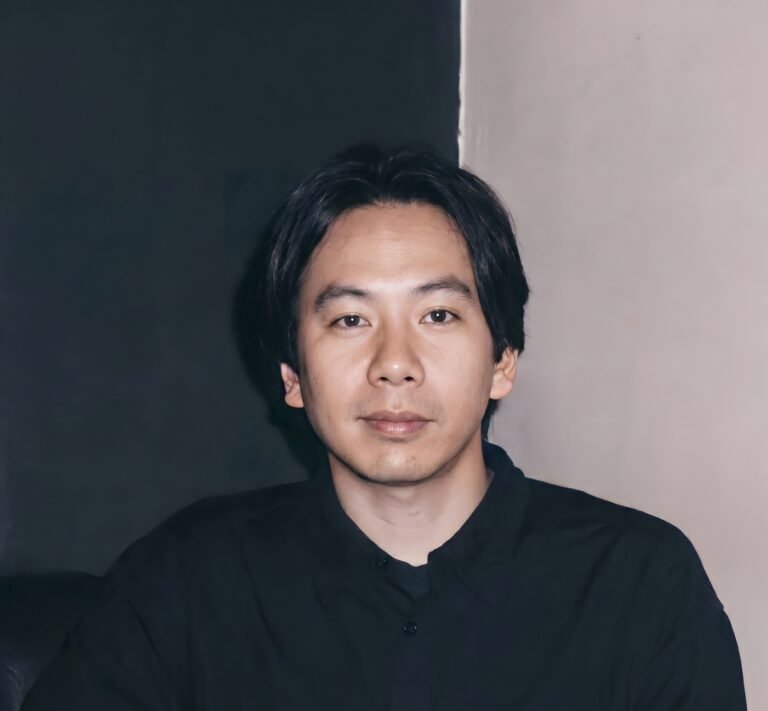
Shinya Tsuakamoto inhabits that dangerous, foreboding grey scale zone between lunacy and genius. At only 34, he has three features and several award winning shorts to his name, revealing an acute and blistering talent. Who could have guessed that this quiet and unassuming young fine arts graduate would have gone on to debut with such a blistering, eye scorching, deliciously and deliriously demented piece of work?
These are scenes quite unlike any other, eschewing the West’s usual fixation with android and cyborg manifestations, and instead having the protagonist fall foul of a demented “metal fetishist”, who torments the main character as he slowly transmutes into a metal / human hybrid. This psychic connection is related to a car crash at the beginning of the film, but in many ways this is an abstract melee of unfettered emotional turmoil – resulting from physical, sexual and psychic tension.
Tetsuo is far from Shinya’s first effort. He made his first films at 14 (Super –8 shorts). Tsukamoto’s sincere dedication to this art form led him to build a small theatre at the age of 17 with which to trawl his super-8 efforts around and screen them. The Japanese TV show Ginza Now! screened three of his early takes after persuasion from the director.
As interesting as his work is, the marking out his sublime visual genius is the fact that Tsukamto also edits, acts, lights, helps shoot, manufactures special effects and pyrotechnics in several of his films. This perhaps smacks of control freakery, but somehow the charge won’t stick and the term visionary seems much more appropriate.
Following the success of Tetsuo, he made a studio film (as yet unreleased in Europe) called Hiruko The Goblin, aimed more at the family market, perhaps the Japanese equivalent of a teen slasher. However, this, although much mellower than the body horror series, is still a visceral film, featuring demons, occult madness and beheadings at a high school!
Finding the studio system too restrictive, Tsukamoto returned to became an auteur once more and constructed the sensational Tetsuo II, worked in colour, featuring himself as yet another mysterious antagonist. The London based Institute of Contemporary Arts (ICA) had brought Shinya over to promote it, and it was here that I met him. On my way to the interview, I passed a baffled looking Times journalist and photographer, but as Shinya needed an interpreter, perhaps it was just a case of things getting lost in translation.
It was probably, as I was to find out, more likely his quiet intensity and minimalist answers that unsettled them. It was as if he was almost being secretive, quietly evasive in some way. However, he was utterly charming, with a impish sense of humour, as did his two co-stars who were joining him – the lovely Nobu Kanaoko and Kei Fujiwara. Shinya first explained his inspiration and reasons for making the first Tetsuo film.
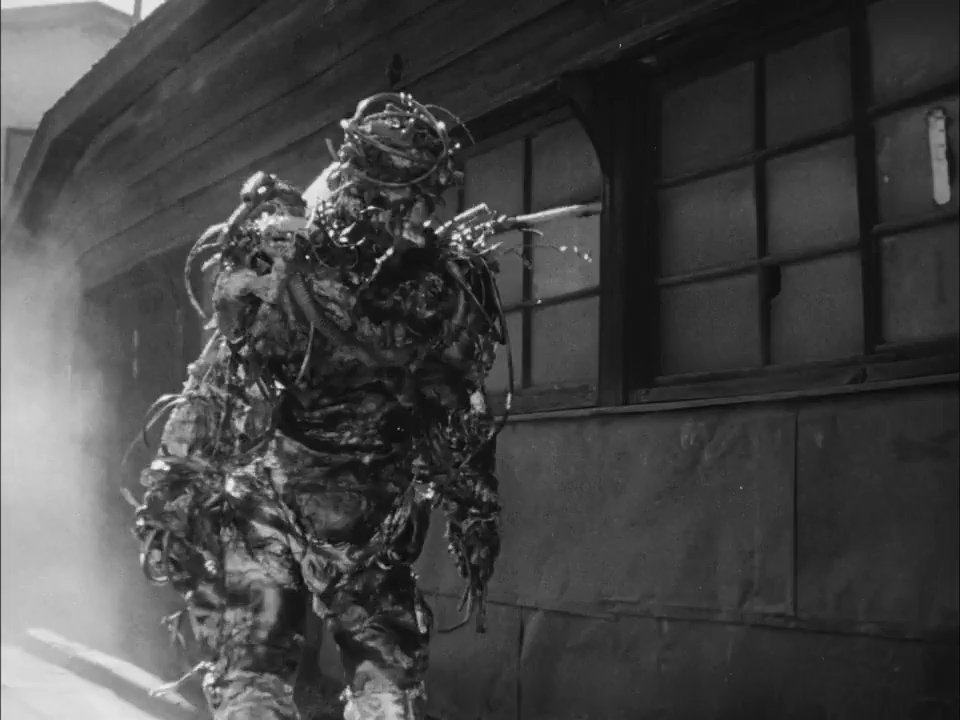
‘The image that I had was of a man and steel going crazy together. In essence, it’s a revenge story, so when the main character hits and runs over the man that I play, pieces of metal hit my face and that’s when my character begins to be a telepathic spokesman for the iron and steel, so that pain remains with the guy character and he wants to make the main character experience the same pain – revenge.’
Tsukamato plays one of the main characters in both Tetsuo films, and both are the protagonists. He explains the reasoning behind this – ‘I think there is in me a bit of masochistic streak – but in a way, I put that into the main character, and I myself would get some distance from the main character and become one of the people who torments him, and in a way, I can identify with both the different sides, the opposite sides, and be in the feeling of the main character at the same time.’
One strong element that runs through the first Tetsuo is that of sexual tension and perversity. I asked the director why this was a highlighted theme. ‘One thing is that I think that the sex in Japanese society is kind of repressed, so that might have been a factor. Also I wanted to use this as a metaphor of steel and metal entering the human body.” Indeed he states that this was the main feeling he intended to portray in the film – “ … the darker side of sex, but by doing it in an atmosphere … a type of punk sort of thing.’
A true auteur, Tsukamoto not only directed and starred in the film, he also is credited as executive producer, writer, co-cinematographer, art director and incredibly also found time to do the startling special effects, including the stop-motion live animation and make-up, applying gelatine and metallic effects. He also engineered the mechanical effects as well.
The sequel, Body Hammer, is essentially a remake – shot in colour on 35mm, with a larger cast and scope. He achieves some wonderful shots of the Tokyo skyline, and clearly has a talent for cinematography, using filers and camera effects to create highly dramatic and visually searing scenes. Where, in the original, pseudo sexual tension drove the subplot, in Tetsuo II, the conflict is centred between two brothers, something that relates to his own personal experience. ‘When I was small, I used to fight a lot with my brother and also with my main actor Taniguchi and myself, it naturally came to be that kind of relationship (laughs).’
Family relationships in general are explored further in this film – ‘With Tetsuo, it was just that one person, one generation, but with Tetsuo II I wanted to create a continuation of generations coming after one another and so I wanted to create a father of Tetsuo, and a human mother, and it sort of continued in line. With the second film, I wanted to portray the people in connection with their lives in the city.’

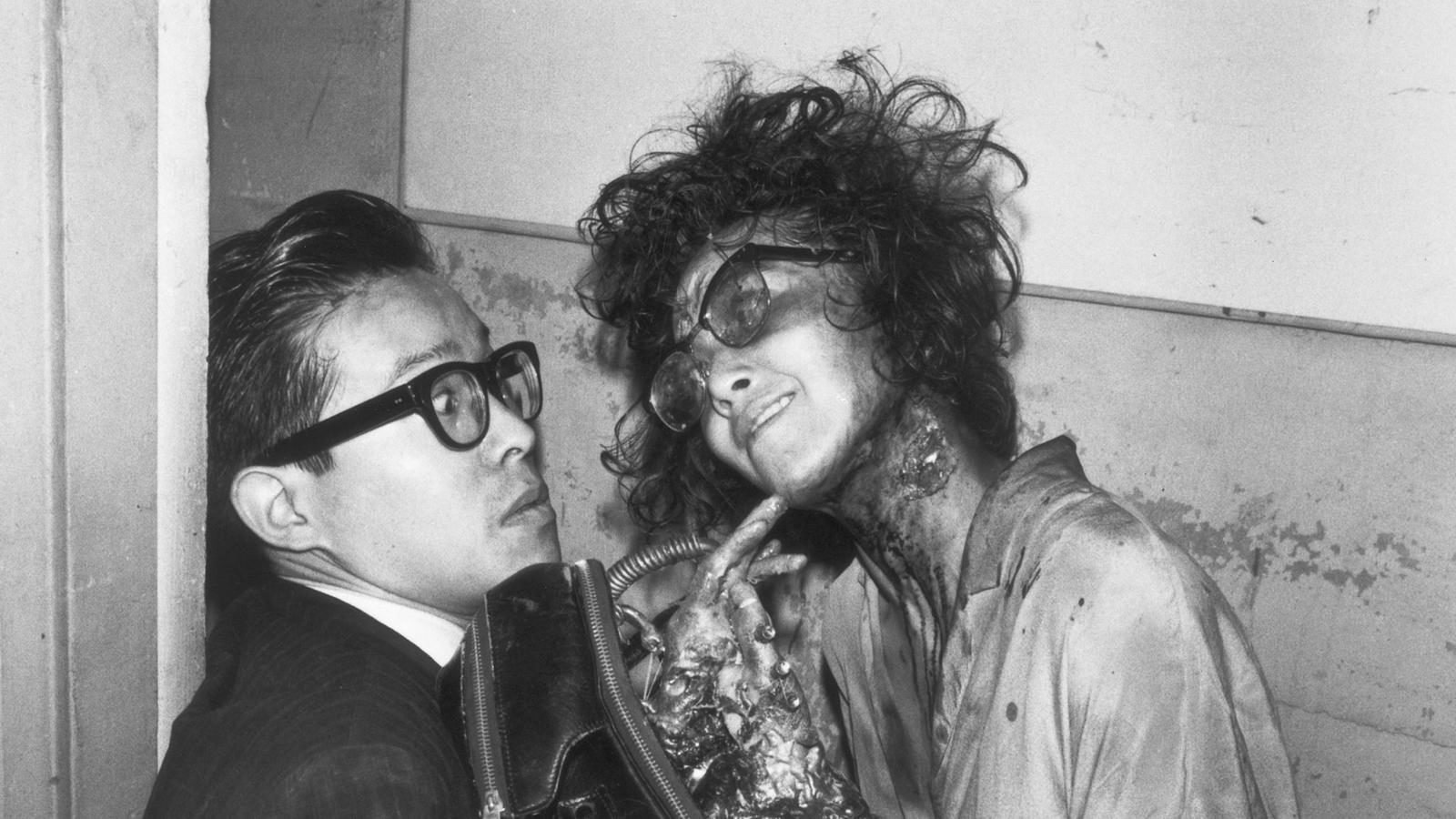


The Tetsuo films are undoubtedly very disturbing, hideously gory in places, and very uncomfortable viewing. Besides this element in the films, Shinya employs some very emotional scenes to profound effect, such as the death of the two main characters’ son in Tetsuo II, shown in graphic detail. Such emotive scenes proved hard for the actors.
‘This is more difficult for my main actress – Kanaoka (Nobu Kanaoka who plays Kana) than for myself because it was a kind of story where characters become completely destroyed and quite emotional. It’s difficult to come back to that same state (of mind) when the shooting of it is stretched out and quite long. It’s difficult to maintain that level of performance.’
I was fascinated by Tsukamoto’s depiction of violent, destructive technology being unleashed and uncontrolled, with scenes similar to Katsuhiro Otomo’s groundbreaking anime film, Akira, and wondered why this was almost an obsession of his in the film, and what was the mentality behind this.
‘I think we feel that on the one hand the city or the urban landscape is very beautiful, but on the other hand we have the urge to destroy it because it’s something that has been handed down to us from generations above us. We take pleasure in such destruction.
I think the kind of technology – the mass technology that would destroy us is still not the most advanced – and my ideal is to have a kind of society where technology is so sophisticated that we can actually co-exist in peace and harmony – that is my ideal, one of my visions.’
To hear this from the director of some of the most graphically violent and visually nightmarish films on earth is quite a surprise, but perhaps Tsukamoto is exorcising his internal demons through film, perhaps even Japan’s generational trauma and horror following the nuclear attacks in WW II, and I am sure these themes and supranatural energies will continue on in his future projects. Certainly, once you have watched his films, you will never forget them, and I feel certain that in the future pantheon of great Asian directors, he will be highly regarded.